
Headlines of more teachers masks a more mixed picture on teacher shortages underneath
Friday 12 June 2026

This blog was first published in Sec-Ed on Wednesday 10 June.
A key headline from last week’s Department for Education (DfE) school workforce statistics is the further progress the Government has made towards its 6,500 teacher target, with 4,654 more teachers above its 2023/24 baseline in the parts of the system DfE is targeting.
However, the data shows a more mixed picture on some important metrics that assess whether the school system has the teachers that it needs.
This opinion piece summarises five key metrics and unpacks what they mean for understanding the state of teacher supply.
Together, they emphasise the need for policymakers to remain focussed on ensuring a healthy supply of high-quality teachers is sustained to address the damage that has been done from many years of teacher shortages.
Retention has improved markedly
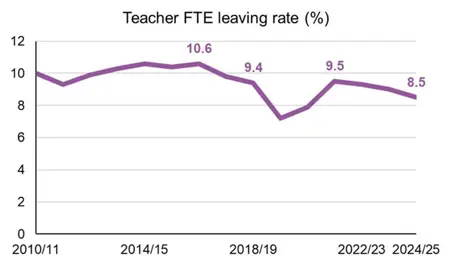
A key teacher supply trend over the last few years has been the remarkable improvement in teacher retention. This is an unambiguously good thing that is benefitting teacher supply. Outside of the exceptional circumstances of the Covid-19 pandemic, the leaving rate is the lowest it has been since the School Workforce data collection began in 2010.
The magnitudes may seem small, having fallen by around one percentage point between 2016 and 2019 and another percentage point since the pandemic. But it is important to recognise that each percentage point represents thousands of teachers.
For example, the fall in the leaving rate from 9.0 per cent last year to 8.5 per cent this year equates to 2,100 fewer teachers leaving the profession.
The leaving rate has a major and direct impact on the teacher supply targets, as a key driver of trainee need is replacing the teachers who leave. Crucially, the targets that DfE published in April made a forecast that the leaving rate would be close to stable last year. However, the fact that it has fallen again for both primary and secondary is likely to put further downward pressure on next year’s ITT targets.
Source: School workforce in England 2025 – leavers.
Fewer vacancies is a sign
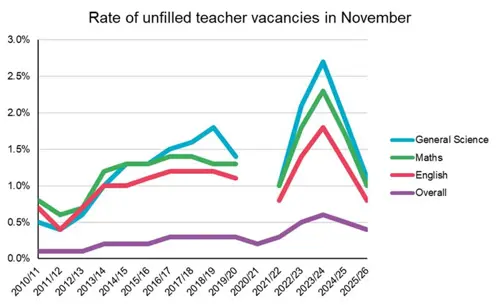
As we predicted in our teacher labour market report in March, the rate of unfilled vacancies has continued to fall this year from its peak in 2023/24. Vacancies going unfiled for extended periods can be a sign of chronic shortages and is likely associated with pressure on existing staff to cover the gaps. That fewer teacher vacancies are going unfilled is a positive sign.
The fall has been across the board, with maths, English and science seeing the vacancy rate fall from the 2023/24 peak. However, the vacancy rate remains higher in these secondary subjects than the overall average, suggesting there is more to do to ensure supply is sufficient in enough areas to fill these vacancies.
Source: School workforce in England 2025 – vacancies.
New trainee entrants fell, even though ITT enrolments had increased
Trends in the number of trainee teachers enrolling in courses is closely followed – not least by us at NFER – as one indicator of the health of supply flows into the system. The number of trainees enrolled in 2024/25 was 6.3 per cent higher than it was in the previous year. This suggests that the newly trained entrants should also be around six per cent higher, as the flow of trainees better meets schools staffing needs.
However, the number of newly-trained entrants in 2025/26 was lower than the previous year, falling from 16,928 to 16,303. This suggests that other factors are at play, affecting the conversion of trainees into state-sector teachers.
This could reflect supply-side factors such as more teachers finding jobs outside of the English state sector (such as in schools abroad) or more trainees finding it harder to secure jobs (for example, international trainees struggling to find a visa sponsor). It could also reflect demand-side factors, such as tight school budgets and higher retention putting a squeeze on trainee recruitment.
The fact that the number of unfilled vacancies has fallen suggests that the latter may be more of a factor. Therefore, increased optimism about meeting the 6,500 teacher target due to improved teacher recruitment and retention flows could be undermined by schools having limited capacity and budget to actually employ more teachers, despite their availability.
The extent of specialist teaching in secondary schools fell
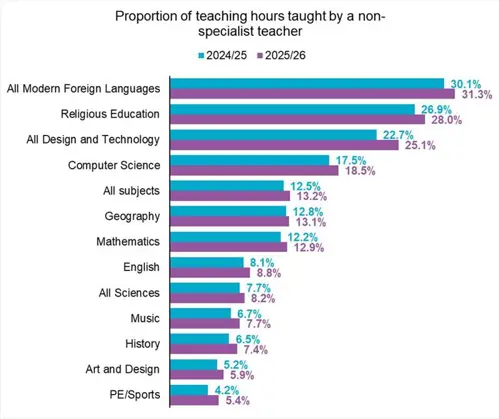
A key reason why teacher supply matters for education quality is that filling the gaps that secondary teacher shortages create leads to teachers being deployed to teach outside their specialism, which affects the quality of teaching. Many years of under-recruitment in maths has resulted in one in six lessons in key stage 3 (years 7-9) being taught by non-specialist teachers and one in eight across all secondary year groups.
That picture continues to be the case. It has even worsened slightly in the latest data, with more teaching by non-specialists in many subjects this year compared to last year.
Overall, the proportion of teaching by non-specialists has increased from 12.5 to 13.1 per cent. All the core subjects featured in the chart below have seen non-specialist teaching increase, which is the opposite of what one would expect if the teacher supply challenge was being tackled effectively.
Source: School workforce in England 2025 – specialist teaching in secondary schools.
Secondary class sizes have continued to rise, despite healthier teacher supply
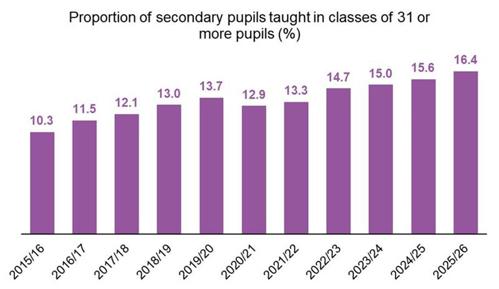
Another sign that the underlying staffing challenges in schools are not yet being adequately addressed by sufficient teacher supply is class sizes. While pupil-teacher ratios and average class sizes in secondary overall are broadly stable, the proportion of pupils taught in classes of more than 30 pupils has increased slightly this year from 15.6 per cent [JJ3] to 16.4 per cent.
The data shows that the proportion has continued to grow since the pandemic years and has not fallen back in recent years in the same way that teacher vacancies have.
One might have expected this to fall given the signs of more healthy teacher recruitment and retention. Again, this may indicate that some schools are still facing significant staffing challenges.
Source: Schools, pupils and their characteristics 2025/26 – class size.
No time for complacency
Despite the progress made towards the 6,500 teacher target and improved retention and vacancy rates, sustained progress will be essential to reverse the damage that previous under-supply has caused to the extent of specialist teaching in shortage secondary subjects and particularly in schools serving the most disadvantaged communities.
This is not a time for policymaker complacency on teacher supply. Ensuring teaching is sufficiently financially attractive and prioritising teacher workload reduction would help protect the fragile progress that has been achieved so far.